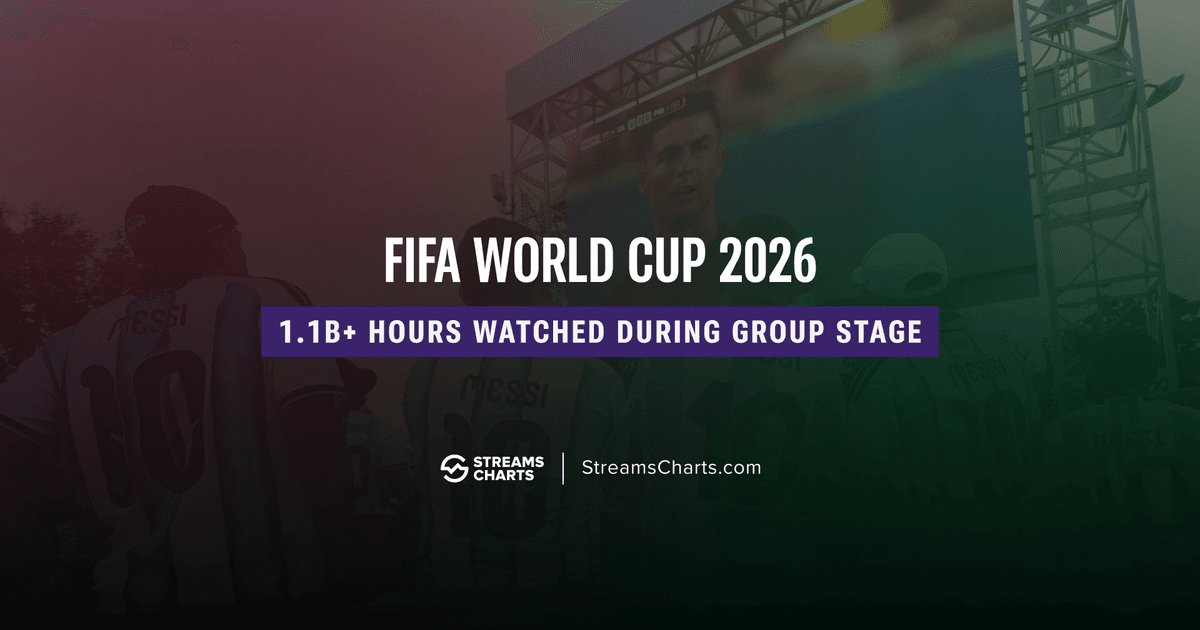
The 2026 FIFA World Cup has become the biggest live streaming event of the year, generating over 1.1 billion hours watched across platforms tracked by Streams Charts during the group stage. The total includes not only licensed match broadcasts, but also watch-alongs, live commentary, simulations and other World Cup-related content produced around the tournament.
Beyond its global scale, the event provides a clear view of how premium sports rights, regional distribution models and creator ecosystems affect platform performance, viewer behavior and brand discussions.
Key takeaways
- FIFA World Cup-related live streaming content generated over 1.1 billion hours watched during the group stage across live streaming platforms tracked by Streams Charts.
- Average YouTube Live audience increased by over 1 million live viewers (+14.5%) since the 2026 FIFA World Cup compared to results for the rest of the year.
- Naver’s YouTube and CHZZK reached new all-time audience records on the platform during the tournament.
- Licensed shows dominated viewership in some markets, while community content generated the majority of viewership in others.
- Increased sponsorship visibility for brands like Coca-Cola and Adidas has shown that the natural association with football helps drive viewer discussion.
YouTube dominates as regional platforms reach new heights
Analysis includes licensed match broadcasts as well as live commentary, viewings, watch parties, simulation streams and supporting coverage such as previews, interviews, press conferences and post-match analysis. Viewing on linear TV and unsupported proprietary streaming services is not included.
Between June 11 and June 29, when the extended group stage took place, all live streaming platforms accumulated more than 1 billion hours watched, according to Streams Charts. This includes what viewers saw live during the matches and other 2026 FIFA World Cup-related content generated around those matches.
Brazil generated the highest World Cup audience activity on YouTube. Directed by Casimiro »CazéTV”Miguel, the platform has repeatedly broken its all-time high viewership record during matches involving the Brazilian national team.

YouTube More than 1 billion hours of viewing time alone were recorded, representing 94.3% of all World Cup-related viewing time recorded during the group stage.
The platform’s average concurrent audience grew 14.5% compared to the first five and a half months of 2026. Much of this increase came from strong audience activity in Brazil, Africa and Southeast Asia, where official broadcasts and community content generated substantial regional interest.
Twitch moved in the opposite direction, with average viewership down more than 7.5% from the lead-up to the tournament. Unlike YouTube, the platform did not see a wider increase in its audience during the group stage.
Also read: 2026 FIFA World Cup Live Stream: Rights holders dominate as independent coverage fills gaps
The difference partly reflects the limited availability of licensed match streams on Twitch, where World Cup-related activity was primarily focused around creator commentary and community coverage rather than the matches themselves.
The South Korean coverage also emerged as one of the most important regional segments of the tournament. CHZZK and SOAP saw substantial increases in average viewership as local audiences followed both licensed shows and associated content from community streamers.
CHZZK reached over 4.9 million Peak Viewers during the group stage, setting a new record on the platform. The result also surpassed Kick’s all-time high of 4.6 million viewers, although CHZZK primarily operates in the South Korean market.

Nearly 70% of World Cup viewing time was generated by streams broadcast during matches. This category included licensed match broadcasts as well as live commentary, viewings, watch parties and simulation-based streams.
The remaining 30% came from tournament media coverage, including previews, post-match analysis, press conferences, interviews and recaps. Mainstream media outlets accounted for much of this content, alongside community and IRL streamers covering the event outside of match windows.

Among the channels and platforms covered by this analysis, no licensed live match broadcasts were identified for the United States, Mexico or Argentina during the group stage. Their World Cup audiences therefore came entirely from comments, views, simulations and other community content.
This does not mean that these countries lacked national media rights holders. Rather, their coverage of licensed matches was either distributed via television and proprietary services outside the scope of Streams Charts, or had not yet been activated on the platforms followed (such as, for example, Darren’siShowSpeed“Watkins Jr.).
The balance could shift further during the knockout stage if additional rights holders begin to distribute match coverage via public live streaming platforms.
The balance between licensed and community content varied significantly by market. Brazil and South Korea, the top two countries in terms of World Cup-related viewing time, were both primarily driven by official rights holders, with licensed broadcasts accounting for more than 65% of total hours watched in each market.
Licensed rights holders also generated the majority of viewership in Colombia, Nigeria and Qatar. Along with Brazil and South Korea, these markets illustrate how official broadcasters can remain the primary destination for live audiences when match coverage is widely available on accessible digital platforms.
Official sponsorship did not always translate into deeper discussions

Official World Cup sponsors recorded mixed changes in live chat activity during the group stage. In this analysis, discussions about the brand are measured through mentions in chats tracked by Streams Charts on YouTube, Tic and kick.
These numbers reflect how often the public discusses or posts about a brand. They should not be interpreted as a direct measure of screen exposure, sponsorship value or overall campaign performance.
Coca-Cola, Visa and Adidas saw increases of between 5% and 15% in their share of tracked chat mentions during the group stage. McDonald’s, Hyundai, Kia, Hisense and Aramco moved in the opposite direction, receiving fewer mentions than in the pre-tournament comparison period.
Brands long associated with football, including Adidas and Coca-Cola, were among those that generated higher chat activity. However, the available data do not suggest that this effect applies consistently to every sponsor or platform.

Betano represented a different type of case. The betting brand saw a sharp increase in chat mentions during the group stage, but much of this activity came from creator-led affiliate campaigns rather than exposure from official World Cup sponsorship.
Sponsorship links and promotional messages have been repeatedly posted by creators and viewers, including on Cut. This demonstrates how affiliate activity can generate substantial brand discussion independent of traditional sponsorship placements.
This case also highlights an important limitation of chat-based metrics: a large increase in mentions may reflect promotional repetition rather than organic audience interest.
The 2026 FIFA World Cup group stage shows that the impact of live streaming a major sporting event extends far beyond official match broadcasts. Rights holders generated most of the audience in markets like Brazil and South Korea, while creators, commentators and simulation channels played a larger role elsewhere.
For broadcasters, platforms and sponsors, hours watched remains a central audience metric, but it does not reflect the full digital footprint of the tournament. Understanding where viewers are watching, what distribution models are focusing their attention, and how audiences are discussing brands provides a more complete picture of the value generated around the event.
Header image via AP
FAQs
How many hours watched did the 2026 FIFA World Cup group stage generate live?
The 2026 FIFA World Cup group stage generated over 1.1 billion hours watched across live streaming platforms tracked by Streams Charts.
Which platform dominated viewership for 2026 FIFA World Cup live streams?
YouTube alone accounted for over 1 billion hours watched, or 94.3% of all World Cup-related watch time during the group stage.
Did any regional platforms set new audience records during the 2026 FIFA World Cup?
Yes, YouTube and Naver’s CHZZK both reached new all-time audience records on the platform during the tournament.
How did Twitch viewership compare during the 2026 FIFA World Cup group stage?
Twitch’s average viewership declined by more than 7.5% from the lead-up to the tournament, unlike YouTube, which saw an increase.
PakarPBN
A Private Blog Network (PBN) is a collection of websites that are controlled by a single individual or organization and used primarily to build backlinks to a “money site” in order to influence its ranking in search engines such as Google. The core idea behind a PBN is based on the importance of backlinks in Google’s ranking algorithm. Since Google views backlinks as signals of authority and trust, some website owners attempt to artificially create these signals through a controlled network of sites.
In a typical PBN setup, the owner acquires expired or aged domains that already have existing authority, backlinks, and history. These domains are rebuilt with new content and hosted separately, often using different IP addresses, hosting providers, themes, and ownership details to make them appear unrelated. Within the content published on these sites, links are strategically placed that point to the main website the owner wants to rank higher. By doing this, the owner attempts to pass link equity (also known as “link juice”) from the PBN sites to the target website.
The purpose of a PBN is to give the impression that the target website is naturally earning links from multiple independent sources. If done effectively, this can temporarily improve keyword rankings, increase organic visibility, and drive more traffic from search results.